 First, we were using a number of outdated materials, such as old CTs. Our access to and mastery of clinical images, particularly MRIs, was limited.
Materials of Limited Usefulness
 Embedded body sections were only marginally useful,
Rationale for Development: Cross-sectional Anatomy Instruction c. 1992
Development Issues
Technical Issues: Hardware and Software
Cross-sectional Anatomy Tutor Demonstration
- a "slide show" of screen captures.
Summary of Program Features
Cross-sectional Anatomy Tutor, the instructional application that incorporates images from the Visible Human data set, is available on CD-ROM for Windows only. For ordering information, please refer to the
AnatomyCD Web page.
Out-dated Materials
First, we were using a number of outdated materials, such as old CTs. Our access to and mastery of clinical images, particularly MRIs, was limited.
Materials of Limited Usefulness
Embedded body sections were only marginally useful,
Labels Awkward/Overwhelming in Atlases Inadequate Images for Testing
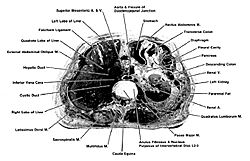 and students found the "porcupine" approach to labeling images in most cross-sectional atlases awkward and overwhelming. The extent of a structure often was not apparent, particularly on CTs and MRIs. Students also found it difficult to orient to cross-sectional images.
Lack of Correlated CTs or MRIs
 The lack of exact correspondence between clinical images and body sections in Atlases made comparison cumbersome and inefficient.
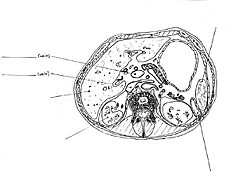 Finally, our testing methods were unsatisfactory because of the low quality of reproduced images that were available to us.
One-to-One or Small Group Approach
 Some of these problems could be solved by working with students one-on-one, or in small groups of 2 or 3 students. However, finite lab contact and staff time limited the efficacy of this approach.
 Thus, in 1992, we began to explore options for improving the efficiency and effectiveness of our cross-sectional anatomy teaching efforts, and to integrate this material into the basic and clinical sciences curriculum. We focussed on transverse views of the human body, in order to maximize the application of this instructional material to the students' later experience with CTs and MRIs in the clinical setting.
With support from the School of Medicine and in conjunction with the Division of Audiovisual Education at Duke, we developed a prototype of a cross-sectional anatomy computer tutorial. We were able to obtain permission to use the Nasco Life/form (NASCO, Fort Atkinson, WI) abdomen images in-house. However, these images were not ideal for our purposes because there were a limited number of levels available, and copyright restrictions on these images were a potential problem for distributing the program to other medical schools. Furthermore, the NASCO images did not include correlated CTs or MRIs, and the images were from one elderly male individual with poor muscular development and some significant pathology, including a missing kidney.
When we learned in 1993 of the forthcoming Visible Human images, we quickly realized that these images represented a significant improvement for our purposes over the NASCO images:
