Deathwish Marketing
Deathwish Marketing in Action
Professor John M. McCann
Fuqua School of Business
Duke University
March 28, 1995
 A controversial and impactful book, The Marketing Revolution (Kevin J. Clancy & Robert S. Shulman, Harper Business), appeared in 1991, and this book uses a number of examples
to illustrate the notion that well-meaning managers can destroy
a business by their mis-placed efforts.
A controversial and impactful book, The Marketing Revolution (Kevin J. Clancy & Robert S. Shulman, Harper Business), appeared in 1991, and this book uses a number of examples
to illustrate the notion that well-meaning managers can destroy
a business by their mis-placed efforts.
They coin the phrase
death wish marketing, and define it to be those efforts
that managers, unconsciously or unknowingly, undertake to kill
a product, brand, or occasionally, an entire company.
We have been able to observe a form of death wish marketing being
practiced by manufacturers in the consumer packaged goods business
for the past decade or so. During that time, marketing managers have unknowingly undertaken marketing programs that converted brand equity into short term retail volume.
 These managers were provided with a Marketing Management Information
System (MMIS) and taught how to use it to extract scanner data and to
use the system's facilities for converting those data into information. That is, the underlying data in the MMIS was data about retail sales in different markets, along with the associated prices and promotion activity levels. Managers interact with the MMIS to produce "reports" that consist of rows and columns of numbers and/or graph that display the data. We use the term information to distinguish these reports and graphs from the underlying data elements.
These managers were provided with a Marketing Management Information
System (MMIS) and taught how to use it to extract scanner data and to
use the system's facilities for converting those data into information. That is, the underlying data in the MMIS was data about retail sales in different markets, along with the associated prices and promotion activity levels. Managers interact with the MMIS to produce "reports" that consist of rows and columns of numbers and/or graph that display the data. We use the term information to distinguish these reports and graphs from the underlying data elements.
Once the managers got the information onto their screens, they would
then use their knowledge of marketing and merchandising to generate
insights and perhaps competitive marketing programs. The question
arise, though, about what will these managers see? What will
they elect to do with their information systems?
 A decade has passed and the evidence is in ... we know what they
tended to do with their systems. They tended to do what was easy
to do ... to see what was easy to see in the data. They would
get a few columns of numbers from their database, and graph these
numbers so that they could see what was happening over time.
A decade has passed and the evidence is in ... we know what they
tended to do with their systems. They tended to do what was easy
to do ... to see what was easy to see in the data. They would
get a few columns of numbers from their database, and graph these
numbers so that they could see what was happening over time.
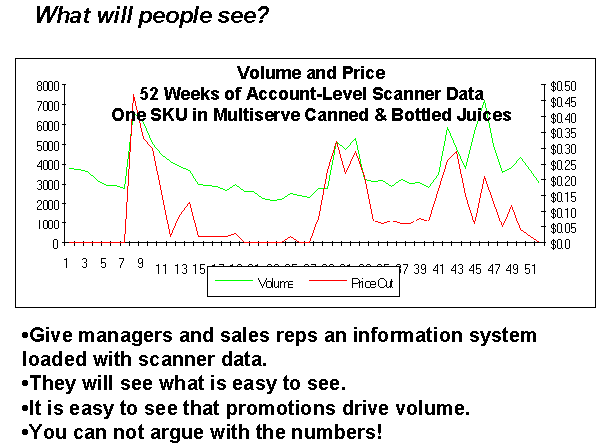
A typical graph would display weeks along the horizontal axis
and both retail sales volume and retail price cut along the vertical
axis. Given this display of information, it was easy for them
to see that when they got a deep price cut from the retailers,
they tended to get a big jump in volume. Although this jump was
only temporary (it went away when the price returned to its normal
level), the volume spike was significant enough to provide them
with a significant amount of revenue. It was not uncommon for
a price promotion to generate 4-6 weeks of normal volume in only
one promotion week.
Who could argue with the numbers ... retail promotions created
a lot of volume. When it was time to prepare a new annual brand
plan, the brand manager found that it was easy to argue for an
increase in promotion expenditures so that even more volume could
be generated by retail promotions. Senior management was always
giving the brand manager new volume targets, ones that were higher
than last year's target. Unfortunately for most of these managers,
their brands were in product categories that were not growing,
or were growing at a rate that was significantly less than the
growth rate that was desired for almost all the brands that comprised
the category.
Since the brand managers could not meet their growth goals through
product category growth, they had to take the volume from some
other brand. How to do that was staring them in the face ...
they could see it in their graphs. Just do more promotions, or
get the retailer to give them a deeper price cut on the same number
of promotions, and everything would work out.
 But, alas, things did not go as expected, particularly in the
long run. Again, time has passed and we can see what happened
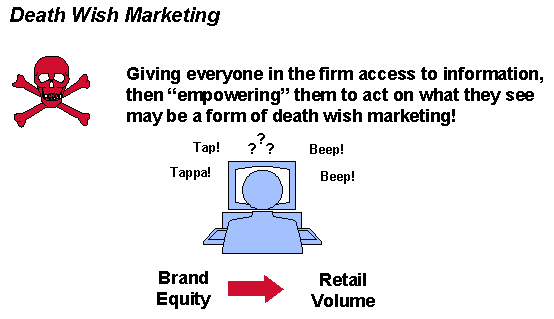
because the "long run" has come about. When firms 1)
gave all these managers access to information via powerful personal
computers connected to huge databases, and 2) empowered them to
act upon what they find in those data, they created a situation
in which death wish marketing could prosper.
But, alas, things did not go as expected, particularly in the
long run. Again, time has passed and we can see what happened
because the "long run" has come about. When firms 1)
gave all these managers access to information via powerful personal
computers connected to huge databases, and 2) empowered them to
act upon what they find in those data, they created a situation
in which death wish marketing could prosper.
By doing what was easy to do, the managers did not do what was
hard to do, which is to ascertain how all the elements of the
marketing mix affect volume and profitability, in both the short
and long term. They learned how temporary price cuts, retail
displays, and retailer advertising features were impacting short
term volume. But they did not see how these promotional activities
were impacting the very essence of their businesses: their brand
equity.
It has become painfully clear to senior managers in most of these
firms that, by chasing promotional volume, they were destroying
their brand equity. But how could this be? How is it that a
retail sale can destroy brand equity? As consumers, we should
all know the answer to that question. If were are able to buy
an item on sale, then we begin to wonder why we ever paid full
price for the item. Pretty soon, we stop buying it unless it
is on sale. Manufacturers made this easy for us by having a number
of retail promotions each year, and by scheduling them in ways
that make it easy for the observant consumer to pick up the patterns.
The consumer then simply buys "from deal to deal" without
buying any of the brand when it is not on deal.
Such deal buying and stockpiling is only one way that brand equity
was impacted. We now understand that brand equity can also be
eroded when most of the brands in a category increase their level
of dealing. A consumer will spot a good price on a brand that
is different from her regular brand and give it a trial. She
finds that it is ok and thus adds it to her consideration set
... the set of brands that she will buy to meet her product needs.
In this instance the consumer may have been totally loyal to
another brand, but is now willing to buy either one ... whichever
one is on sale. Thus the first brand has lost its brand equity,
and although the second brand has gained retail volume, it has
not increased its brand equity. When you multiply this scenario
throughout the year and the millions of consumers, you find that
the increase in deals throughout the years served to teach consumers
that they are fools to pay full price in a lot of the product
categories.
This awareness by managers of this problem has caused them to
sponsor a new study of the brand equity situation. Researchers
have completed some early work in their study, and have documented
the situation discussed above. They have concluded that it is,
indeed, possible to increase market share at the expense of brand
equity.
For instance, one food brand studied showed a 12% increase in
market share in 1991, driven by a 78% increase in coupon distribution.
At the same time, their models indicated that the brand's equity
dropped 22%, and that this drop was the cause of a share drop
in market share in 1992.
Yes, it does seem that death wish marketing
is alive and well.