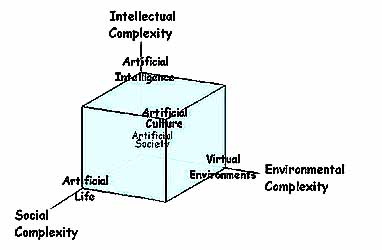
Artificial
Life, Artificial Culture
& Evolutionary Design
Syllabus
![[image of digits]](/cgi-bin/Count.cgi?ft=0|pad=0|dd=B|df=alife02syl.dat)
Honors
69 - Spring 2002 - Nick Gessler
gessler@ucla.edu
|
| |
|
Can
you identify these images?
(click for clues)
|
|
|
|
|


|


|
|
|
|
|
"Science
is what we understand well enough to teach to a computer. Art is everything
else."
Donald Knuth
"Computer
Science is not about computers. It is about the kind of complex systems
that we are."
Marvin Minsky
Revised
18 February 2002
|
|
Tuesday: Lecture/Lab 10:00 - Noon,
Noon - 1:00
Thursday: Lecture/Lab 10:00 - Noon; Office
Hour Noon - 1:00
Additional Office Hours After Class - CLICC Lab, Northern Lights or Lavalle
Commons
CLICC PC Classroom C (Powell 320)
ARTIFICIAL
LIFE, ARTIFICIAL CULTURE AND EVOLUTIONARY DESIGN
is a seminar in the ground-breaking
fields of artificial life, artificial culture, artificial intelligence, virtual
environments, and evolutionary computation which have revolutionized our thinking
about science and our place in the universe. We will take a critical look at
these practices through writings, videos and movie clips on artificial worlds
and practical hands-on engagement with multi-agent simulations and games. Field
trips will be arranged whenever possible. Here are just a few of the issues
we will discuss:
- SIMULATION and VISUALIZATION.
- ART and SCIENCE of synthetic
worlds.
- Virtual environments
and augmented reality.
- Fact and fantasy in
STAR TREK, DARK CITY, THIRTEENTH FLOOR, MATRIX, AI.
- Can software programs,
hardware computers and autonomous robots create, learn and evolve on their
own?
- Can life & intelligence
exist in silicon as it does in carbon?
- Are we "just" programs
running on some "hidden" universal computer?
- Is consciousness an
epiphenomenon? Does it make decisions or simply watch?
- Believe it or not, YOU
can write your own Windows PC simulations! (optional)
Software
to Enhance Your Creativity
You
will have your own Web page up in the first week. You
can use use some of this software in your presentations and in your project,
or even as your project. I will go over all of it once lightly and will spend
extra time with those who have a deeper interest.
- Photoshop
- Dreamweaver
- CuteFTP
- Powerpoint
- Synedit
- Lego Mindstorms RCX
- Borland C++
A Project
to Match Your Interests
The course project is your opportunity
to explore a domain of artificial worlds close to your own interests. It may
include a search of library and web resources, field research, critiques of
popular culture, and/or a simulation written by you. Your project should be
presented as a paper, web, powerpoint document and/or a Windows application.
No Prerequisites
There are no prerequisites other than
an interest in artificial (and natural) worlds. You will have an advantage
if you are comfortable working with PCs, browsing the Web, computer games, and
sending and receiving E-mail. We will spend some time on these skills and you
will have your own website up and running by the end of the first week. Make
sure to contact Bruin-On-Line
to get your own identification, password, email and website. Please familiarize
yourself with the services (including classes) that they offer.
Programming is optional to succeed in this course. We will introduce you to
new visual tools with drag-and-drop components. It is really not that difficult.
Check out the participant
reviews
and the instructor's
profile.
Please
arrive on the first day of class with:
- A Bruin-On-Line
ID, Password, E-mail account, and Website information.
- 20 Floppy Diskettes and one ZIP-250
Cartridge.
- $10.00 for your print account. Printouts
cost $0.10 per page for black and white and $0.40 for color.
Readings:
Good books on this subject
are few and far between. They are usually expensive, have low print runs and
go out of print quickly. I do not know if ASUCLA Textbooks can get these or
what their price will be. If they don't come in or if they are unreasonably
expensive, I will simply Xerox articles for you to read. I will likely assign
each of you one article per week to report on in class. So if there are, for
example, five articles in one week, I will divide you up into five groups and
have each group report on one article. That way we can get through the readings
without it being a burden.
|
required
readings
|
These will form the primary basis
for critiques and discussions in the class. In order to air the ideas
and their implications we will probably divide the readings among several
groups of participants.
|
|
|
REQUIRED:
Current articles and handouts including Computer
Models of Cultural Evolution,
by Nick Gessler.
These will be available on the Web
or from the instructor.
|
|
|
REQUIRED:
Evolutionary Design by Computers, by Peter Bentley (Editor)
List Price: $62.95
amazon.com
= $62.95 plus shipping and handling
available from ASUCLA
This book will also
be available on reserve.
|
|
|
REQUIRED:
Artificial Life, by Christopher G. Langton
(Editor)
List Price: $35.00
amazon.com
= $35.00 plus shipping and handling
available from ASUCLA
This book will also
be available on reserve.
|
|
suggested
readings
|
These will inspire your class discussions,
challenges and quarter project.
Anyone who wants to write a simulation as a class project should buy the
guide.
|
|
|
RECOMMENDED:
The Pattern on the Stone – The Simple Ideas that Make Computers Work,
by Danny Hillis. Basic Books, New York (1998). An easy and enjoyable read.
List price $13.
available from instructor = $10.00
|
|
|
RECOMMENDED:
C++ Guide. BarCharts, Quick Study - Computer. A six-page cheat
sheet on the C++ programming language.
List Price = 5.95
available from instructor
= $4.00
|
|
|
RECOMMENDED:
Growing Artificial Societies – Social Science from the Bottom Up, by Joshua
Epstein and Robert Axtell. MIT Press, Cambridge (1996). A quick read for
the overall strategy by week three. More in-depth reading will be assigned.
List Price = out of print
amazon.com
= $24.00 plus shipping and handling
available from instructor = $25.00
|
|
|
RECOMMENDED:
ATLAS OF CYBERSPACE
Martin Dodge & Rob Kitchin
List Price = 39.99
amazon.com
= $27.99 plus shipping and handling
available from instructor = $30.00
|
|
|
RECOMMENDED:
The Computational Beauty of Nature – Computer Exploration of
Fractals, Chaos, Complex Systems, and Adaptation, by Gary William Flake.
MIT Press, Cambridge (1999). Readings will be assigned each week.
amazon.com
= 32.95 plus shipping and handling
available from instructor = $30.00
MIT
Press Website
Java Applets and more...
|
|
|
RECOMMENDED:
Blondie24, by David Fogel. Morgan Kauffman (2001). Tells the
story of a computer that taught itself to play checkers far better than
its creators ever could by emulating the principles of Darwinian evolution
and discovering innovative ways to approach the game.
amazon.com
= 17.46 plus shipping and handling
|
Grading
Formula:
| 8 Weekly Challenges: 5% each = 40% |
Class Participation: (30%) |
Class Project (30%) |
Challenges will be
mostly simulations for you to write, explore, and enhance in code, pseudocode
and procedural ideas. Please keep your own copies since I will
not return what you turn in. I wish to keep them to impress my colleagues
with your work. I will return comments separately, or better yet meet
me over coffee (my treat).

Please turn in the following
for each programming challenge:
- Label everything with your
name and challenge number.
- Cover Sheet - A printout
of the screen image of your application (with your name, class and assignment
number).
- Source Code - A printout
of your source code (e.g. the unit1.cpp file).
- Floppy with your executable
and 6 project files (yes, they will all fit):

|
Includes:
- Postings to the Web
on the weekly readings.
- Discussions in the
classroom, via email, during office hours and over coffee.
- Help you may provide
your fellow participants.
We are always interested in
epistemological issues (how do we know what we think we know), the evolution
of representations (simulations and models), and what may be possible
just around the corner. We would always like our discussions grounded
in technological fact.
- Can computers think?
- Is my brain a computer?
- Why do I hate computers?
- Why are computers stupid?
- Is reality itself a simulation?
- Can we bring coffee to class?
- Are characters in a computer game
alive?
- Can computers have feelings and
emotions?
- Is the world deterministic but
unpredictable?
- Can we build computers out of
DNA or RNA?
- Are we simply agents running on
some enormous computer game?
- What are the issues raised by
the movies
DARK CITY, THE THIRTEENTH FLOOR and AI? How close is fact to fiction?
- If what we know of the world is
represented by an image on our retina which in turn is represented by
neurons firing in our brains, how many levels of representations are
there between ourselves and the external world? Can we ever know that
world directly?
|
Your topic should be designed
around your own interests after consulting with me. Please
keep your own copies since I will not return what you turn in on paper,
floppy and/or Zip disk.
Some ideas:
- Design and write your own Windows
application.
- The life and contributions of
a prominent artificial worlder...
- The evolution of some domain of
artificial world...
- Detailed critique of some film,
narrative or collection of works...
- The work of the SFI, ICT, Military,
Movie and/or Gaming Industries.
- The work in academic disciplines...
Some reflections:
- Description
- Exploration
- Critique
- Explanation
- Understanding
- Knowledge
- Entailments
- Prediction
- Accuracy, Precision & Repeatability
- Representation & Referrent
- Object & Process
|
| PLAGIARISM
is passing off someone else's work as your own. When you use an important
part of someone else's work provide a proper citation. Plagiarized work
will not be accepted. I'm interested in your ideas about what others think
and do. Reflect on other peoples' ideas but it is your critique of their
work that determines your success in this class. Do us all a favor and don't
plagiarize... |