|
Evolutionary
Concert Tour |
|
EQUIDISTANT paths: The difference between the previous and next path segments can be no larger than 33, 1/3 the width or height of the world.: |
|
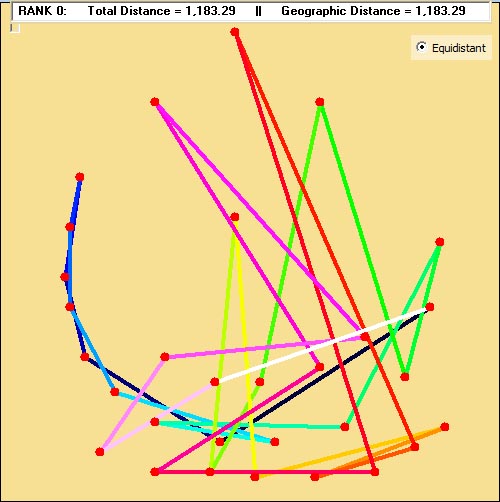 Rank 0: EQUIDISTANT path with minimal change in successive path leg lengths. No penalty. |
 Rank 1: EQUIDISTANT path with minimal change in successive path leg lengths. One penalty. |
 Rank 2: EQUIDISTANT path with minimal change in successive path leg lengths. Two penalties. |
 Rank 3: EQUIDISTANT path with minimal change in successive path leg lengths. Two penalties. |
OTHER paths:: |
|
 The shortest path with NOT CONSTRAINTS. |
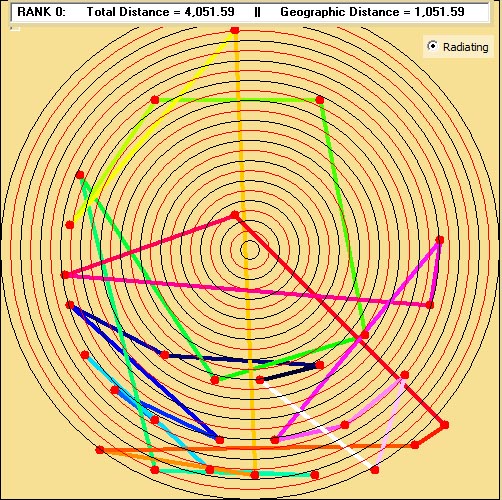 An optimal RADIATING path (with three penalties of 1000 each). |
 An optimal CLOCKWISE path (with three penalties of 1000 each). |
 An optimal EASTWARD path (with three penalties of 1000 each). |
Is it a coincidence that the best solutions with RADIATING, CLOCKWISE and EASTWARD constraints incurred three penalties each? What is the relationship between penalty size and the number of penalties incurred? Would increasing the penalty to 3000 decrease the number of penalties to one? |
|