Background and Preliminaries
-
Produced 431 BC
-
"Cypris" in this play is another name for Aphrodite
Mythic background
A Dream of Passion (Jules Dassin,
1978): The Two Medeas
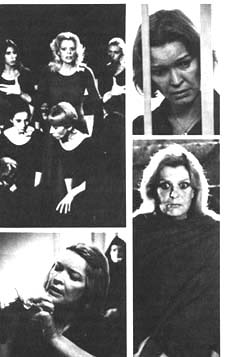
-
Costa (the director) berates Maya (Melina Mercouri, who plays Medea in
the play within the film) for injecting too much of politics into the play:
"Medea is about love, passion, witchcraft" in which the poet has created
"another world" ... it's about "poetry, not current events" But
is he right? Is it true that we are injecting something from our own world,
something alien to the play, in insisting that Medea argues for womanhood
even as she rejects Jason and works towards her terrible deed?
-
Maya does not blame herself for the horrible breakup with Maria earlier
in their lifes (over another man): rather, she blames the man, and -- curiously!
-- her mother, who taught her to think of the other woman, and not the
man, as the enemy, who taught her to find value only through her relationship
to a man:
-
compare in the play line 247 (towards the climax of Medea's famous speech
on the plight of being a woman), and the general relationship built up
in the play between the assertion that the "bed" and "sex" is what matters
to a woman, and the androcentric (focus on the man) world view that is
under question
-
note that in the play, too, the women fully participate in the male construct
of their self-esteem: Medea, even as she criticizes this world view, also
attacks the daughter of Creon as her enemy, and perceives Jason's sleeping
with her as central to her loss of womanly honor
-
As Maya draws closer to the child murderer Brenda, and finds much of Brenda
in herself, she is led by the horror of child murder towards the
rejection of the androcentric (male-focused) world view
-
"Was it justified for Medea to kill her children?" asks the BBC director;
to which Maya replies, "That's the wrong question to ask. Why not ask the
right question instead, which is: what desperation led her to kill her
children?"
Medea as a woman in defiance
of the male view
-
Corinthian chorus: a thiasos of womanhood: they side with her, support
her, even when they disagree: interestingly, this is ON THE BASIS THAT
THEY ARE WOMEN (they, after all, are Greek, and she is a barbarian, so
this surprises)
-
e.g., 267f, 823
-
note esp. striking combativeness at 425f: "if the lyre had not been made
for men, we would have sung an answer to the other sex long ago"!
-
the misfortunes of the woman
-
231ff: marriage (note, once again, how Euripides perverts things, making
what is usually considered positive into a negative!)
-
294ff: being clever (ditto!)
-
Typical, unthoughtful male views of woman are shown up as foolish
-
End of Jason's speech: 569ff (a typical male argument, but in this context
sounds foolish)
-
Medea's speech: 886ff (a satire on a typical male view, and on Jason's
absurd arguments, which again makes the typical male view sound foolish)
-
irony: what motivates Medea's actions is her jealousy over the new bride,
the thought that everyone will laugh at her, that Jason will have a new
bed-partner (the typical male complaints!):
-
see esp. lines 1366ff (!)
-
The play seems in some sense to be a meditation on the different roles
of man and woman in Greek society (one doesn't need a feminist interpretation
to come to this conclusion!), but what sort of commentary is this?
Is womanness in the end honored? Is manness?
-
Medea is, to be sure, the hero of the play, but what sort of hero?
Relationship of Medea to other figures
in ancient drama
-
Christie Wolfgang: compare Jason & Hippolytus (esp. their views on
women!); Medea and Electra
-
Costa Kalorides: compare Medea & Antigone, both criticized by the ruler
as "clever women": but is Medea glorious/victorious at the end?
-
ego: compare Medea and Ajax: help your friends, harm your enemies: cf.
lines 807ff.(!) But why is a woman made an example of this
ancient heroic code?
Medea as a process of inversion:
the two AGONs
-
Compare the first agon at 446ff with the second agon at 1317ff
(both between Medea and Jason, flanking the action of the play):
-
Dialogue begins with character who thingks s/he controls the fate of the
other (446-64, 1317-22), and adopts a superior, exaggeratedly calm and
"reasonable" manner
-
Altercation opens with insults by the weaker antagonist, followed by an
argument; answered by the stronger; then stichomythia (line by line repartee)
-
same insults, accusations, declarations that the opponent's actions have
made him/her an abomination in the eyes of gods and men
-
in both, they regret having met one another
-
In the first agon, Medea catalogues instances of her past kindness, which
is then picked up in the second by Jason as stages in the process of his
misfortune
-
Concluded with a passionate outburst by the weaker antagonist (Medea at
623-26, Jason at 1405-14)
-
These two agons are the cardinal points of the tragedy:
-
they mark the beginning and end of the dramatic action,
-
but also contrast as image and reflection:
-
for the second agon represents an exact reversal of the situation in the
first
-
Between these two points we see the gradual transformation of the initial
situation into its opposite
People and places to know
-
Medea
-
Jason
-
Creon, king of Corinth (NOT the same as the Creon in the Theban plays)
-
Aegeus
-
Helios