
Pin Oak is commonly planted in North Carolina, but fairly rare in the wild, where it occurs in the northern half of the Piedmont. Pin Oak is associated with bottomlands and swamps, as the name palustris indicates.
Durham Co., NC 8/15/2010.
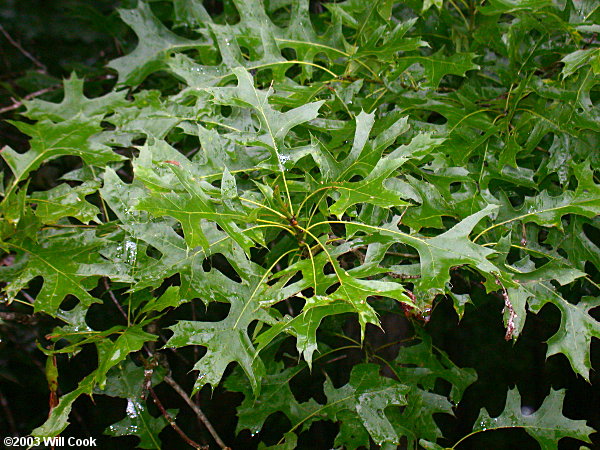
The smooth leaves are distinguised by their deep sinuses. Scarlet Oak (Q. coccinea) also has deep sinuses, but grows in uplands. Shumard Oak (Q. shumardii) also grows in swamps, but the sinuses are slightly less deep and there are tan hairs in the axils of the veins beneath. Also compare with Cherrybark Oak (Quercus pagoda).
The bark and form of Pin Oak are similar to that of Willow Oak (Q. phellos), while the bark and form of Shumard is more similar to that of Northern Red Oak (Q. rubra).
Durham Co., NC 6/8/2003.

Durham Co., NC 10/16/2008.

The bark is similar to that of Willow Oak, smooth when the tree is young, becoming shallowly ridged, broken by shallow longitudinal fissures.
Durham Co., NC 8/15/2010.

Durham Co., NC 10/16/2008.

Durham Co., NC 10/16/2008.

Durham Co., NC 10/16/2008.

Durham Co., NC 10/16/2008.

Durham Co., NC 10/16/2008.

Durham Co., NC 10/16/2008.