Microbicide products are diluted during use by vaginal fluids (vaginal transudate, cervical mucus) and semen. Dilution may change material properties and deployment. We have developed a method for assessing the effects of dilution on deployment and have applied this method to study the effect of dilution on KY Jelly, Replens, and Carraguard.
The gels were diluted 10, 20, or 30% with vaginal fluid simulant or semen simulant. Rheological properties of the dilutions were measured and the data were fitted to constitutive models to find values for the constitutive model parameters. Constitutive models are equations that describe the behavior of a material as a function of shear rate.
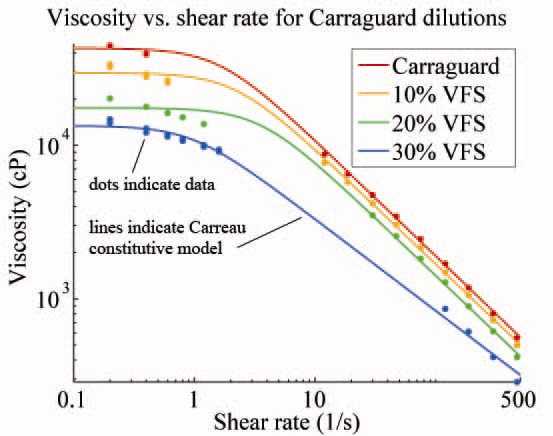
The consitutive model parameters were then input into a mathematical model of constant-force squeezing of a fluid between two plates.

Why use a squeezing model?
- Squeezing forces contribute to gel deployment in the body
- A model of coating flow can be used to interpret changes in rheological parameters
- Calculated areas coated can be used to compare materials

We found that:
- Dilution can substantially change rheological properties and coating flow of a microbicide product
- Dilution affects different materials to different degrees
- Some materials respond differently to vaginal fluid simulant and semen simulant
- Dilution can change rank-order of gels in squeezing model
- This method can be used in screening and design of candidate delivery vehicles to improve effectiveness of microbicide products