
The first (and most important) step in fitting an ARIMA model is the determination of the order of differencing needed to stationarize the series. Normally, the correct amount of differencing is the lowest order of differencing that yields a time series which fluctuates around a well-defined mean value and whose autocorrelation function (ACF) plot decays fairly rapidly to zero, either from above or below. If the series still exhibits a long-term trend, or otherwise lacks a tendency to return to its mean value, or if its autocorrelations are are positive out to a high number of lags (e.g., 10 or more), then it needs a higher order of differencing. We will designate this as our "first rule of identifying ARIMA models" :
If the lag-1 autocorrelation is zero or even negative, then the series does not need further differencing. You should resist the urge to difference it anyway just because you don't see any pattern in the autocorrelations! One of the most common errors in ARIMA modeling is to "overdifference" the series and end up adding extra AR or MA terms to undo the damage. If the lag-1 autocorrelation is more negative than -0.5 (and theoretically a negative lag-1 autocorrelation should never be greater than 0.5 in magnitude), this may mean the series has been overdifferenced. The time series plot of an overdifferenced series may look quite random at first glance, but if you look closer you will see a pattern of excessive changes in sign from one observation to the next--i.e., up-down-up-down, etc. :
An example: Consider the UNITS series in the TSDATA sample data file that comes with SGWIN. (This is a nonseasonal time series consisting of unit sales data.) First let's look at the series with zero orders of differencing--i.e., the original time series. There are many ways we could obtain plots of this series, but let's do so by specifying an ARIMA(0,0,0) model with constant--i.e., an ARIMA model with no differencing and no AR or MA terms, only a constant term. This is just the "mean" model under another name, and the time series plot of the residuals is therefore just a plot of deviations from the mean:

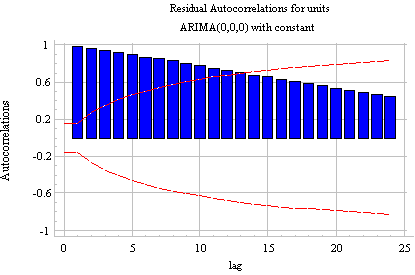
The autocorrelation function (ACF) plot shows a very slow, linear decay pattern which is typical of a nonstationary time series:
The RMSE (which is just the standard deviation of the residuals in a constant-only model) shows up as the "estimated white noise standard deviation" in the Analysis Summary:
Forecast model selected: ARIMA(0,0,0) with constant
                            ARIMA Model Summary
Parameter           Estimate        Stnd. Error     t               P-value
----------------------------------------------------------------------------
Mean                222.738         1.60294         138.956         0.000000
Constant            222.738
----------------------------------------------------------------------------
Backforecasting: yes
Estimated white noise variance = 308.329 with 149 degrees of freedom
Estimated white noise standard deviation = 17.5593
Number of iterations: 3
Clearly at least one order of differencing is needed to stationarize this series. After taking one nonseasonal difference--i.e., fitting an ARIMA(0,1,0) model with constant--the residuals look like this:

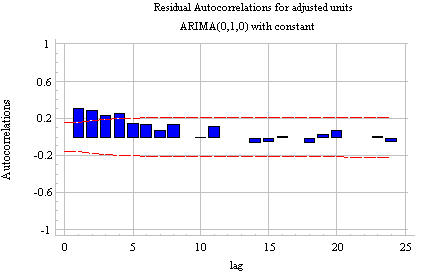
Notice that the series appears approximately stationary with no long-term trend: it exhibits a definite tendency to return to its mean, albeit a somewhat lazy one. The ACF plot confirms a slight amount of positive autocorrelation:
The standard deviation has been dramatically reduced from 17.5593 to 2.38 as shown in the Analysis Summary:
Forecast model selected: ARIMA(0,1,0) with constant
                            ARIMA Model Summary
Parameter           Estimate        Stnd. Error     t               P-value
----------------------------------------------------------------------------
Mean                0.50095         0.141512        3.53999         0.000535
Constant            0.50095
----------------------------------------------------------------------------
Backforecasting: yes
Estimated white noise variance = 2.38304 with 148 degrees of freedom
Estimated white noise standard deviation = 1.54371
Number of iterations: 2
Is the series stationary at this point, or is another difference needed? Because the trend has been completely eliminated and the amount of autocorrelation which remains is small, it appears as though the series may be satisfactorily stationary. If we try a second nonseasonal difference--i.e., an ARIMA(0,2,0) model--just to see what the effect is, we obtain the following time series plot:

If you look closely, you will notice the signs of
overdifferencing--i.e.,
a pattern of changes of sign from one observation to the next. This is
confirmed by the ACF plot, which now has a negative spike at lag 1 that
is close to 0.5 in magnitude:
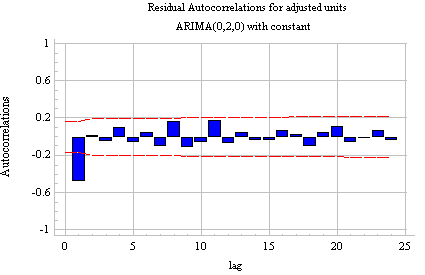
Is the series now overdifferenced? Apparently so, because the standard deviation has actually increased from 1.54371 to 1.81266:
Forecast model selected: ARIMA(0,2,0) with constantThus, it appears that we should start by taking a single nonseasonal difference. However, this is not the last word on the subject: we may find when we add AR or MA terms that a model with another order of differencing works a little better. Or, we may conclude that the properties of the long-term forecasts are more intuitively reasonable with another order of differencing (more about this later). But for now, we will go with one order of nonseasonal differencing.
ARIMA Model Summary
Parameter Estimate Stnd. Error t P-value
----------------------------------------------------------------------------
Mean 0.000782562 0.166869 0.00468969 0.996265
Constant 0.000782562
----------------------------------------------------------------------------
Backforecasting: yes
Estimated white noise variance = 3.28573 with 147 degrees of freedom
Estimated white noise standard deviation = 1.81266
Number of iterations: 1