|
Research Interest |
||
|
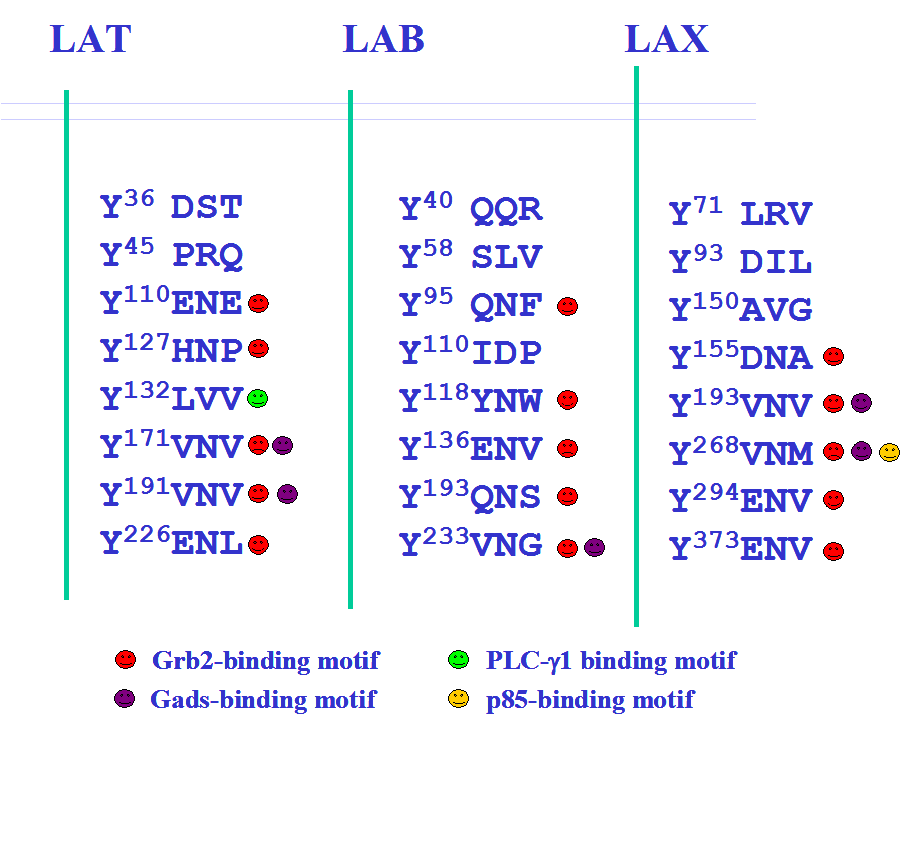
Activation via the antigen receptor (T cell receptor and B cell receptor) triggers a cascade of intracellular biochemical events eventually leading to lymphocyte proliferation, cytokine production, and effector functions. The primary focus of our laboratory is to understand the function of membrane-associated adaptor proteins in lymphocyte activation and development. We are working on three different adaptor proteins: LAT (Linker for Activation of T-cells), LAX (Linker for Activation of X cells), and LAB (Linker for Activation of B cells). These three proteins share a similar domain structure: a short extracellular domain, a transmembrane domain, and a cytoplasmic domain with multiple Grb2-binding motifs. LAT is expressed in T cells, mast cells, NK cells, and platelets. Upon T cell activation, LAT is tyrosine phosphorylated and associates with Grb2, Gads, and PLC-γ1. LAT-deficient Jurkat cells are defective in TCR-mediated Ras-MAPK activation and Ca2+ flux. LAT knockout mice have a severe block in T-cell development. Thus, LAT is essential for T cell activation and development. Recently we mapped tyrosine phosphorylation sites in LAT and demonstrated that LAT interaction with Grb2, Gads, and PLC-γ1requires multiple tyrosines. We continue to dissect the function of these tyosine residues in T cell activation by using mice expressing different LAT mutants. We are also investigating the role of LAT localization to lipid rafts during T cell activation and immune responses. LAX is expressed in T cells, B cells, and mast cells. It is phosphorylated upon BCR, TCR, or Fc receptor cross-linking. LAX interacts with Grb2, Gads, and p85. LAX functions differently from LAT because it fails to rescue defective signaling in LAT-deficient cells. Moreover, overexpression of LAX in Jurkat cells inhibits TCR-mediated p38 activation, suggesting that LAX might be a negative regulator. To examine the function of LAX in vivo, we have generated LAX-deficient mice. We are analyzing these mice to determine the effect of LAX-deficiency on lymphocyte development and function. LAB is expressed in B cells, mast cells, NK cells, and monocytes. Like LAT, it is localized to lipid rafts. Upon BCR or Fc receptor stimulation, LAB is phosphorylated and interacts with Grb2, however not PLC-g1/2. Functionally, LAB can partially rescue defective signaling in LAT-deficient Jurkat cells and thymocyte development in LAT-deficient mice. Currently we are comparing the functional difference between LAT and LAB using transgenic mice expressing LAB in T cells. We are also studying LAB function in vivo using mice deficient in LAB. In addition to these three adaptor proteins, we are trying to identify novel molecules involved in positive and negative regulation of antigen receptor signaling pathways by utilizing biochemical (proteomics), genomic (database searching), genetic (mutagenesis), and functional (expression cloning) approaches. Our long-term goal is to fully understand the antigen receptor signaling pathway. |
||
|
Publications:
Last Modified: October 25, 2004 Zhu, M., Shen S., Liu, Y., Granillo, O., and Zhang, W. LAT localization to lipid rafts is not essential in T cell activation and development. J. Immunol. (Cutting edge). 2004 In press. Horejsí V, Zhang W, Schraven B. Transmembrane adaptor proteins: organizers of immunoreceptor signalling. Nat Rev Immunol. 2004 Aug;4(8):603-16. Abstract Janssen E, Zhu M, Craven B, Zhang W. Linker for activation of B cells: a functional equivalent of a mutant linker for activation of T cells deficient in phospholipase C-gamma1 binding. J Immunol. 2004 Jun 1;172(11):6810-9. Abstract Koonpaew S, Janssen E, Zhu M, Zhang W. The importance of three membrane-distal tyrosines in the adaptor protein NTAL/LAB. J Biol Chem. 2004 Mar 19;279(12):11229-35. Abstract Wen R, Chen Y, Schuman J, Fu G, Yang S, Zhang W, Newman DK, Wang D. An important role of phospholipase Cgamma1 in pre-B-cell development and allelic exclusion. EMBO J. 2004 Oct 13;23(20):4007-17. Abstract Zhu M, Liu Y, Koonpaew S, Granillo O, Zhang W. Positive and Negative Regulation of Fc{varepsilon}RI-Mediated Signaling by the Adaptor Protein LAB/NTAL. J Exp Med. 2004 10 18;200(8):991-1000. Abstract Zipfel PA, Zhang W, Quiroz M, Pendergast AM. Requirement for Abl kinases in T cell receptor signaling. Curr Biol. 2004 Jul 27;14(14):1222-31. Abstract Janssen E, Zhang W. Adaptor proteins in lymphocyte activation. Curr Opin Immunol. 2003 Jun;15(3):269-76. Abstract Janssen E, Zhu M, Zhang W, Koonpaew S, Zhang W. LAB: A new membrane-associated adaptor molecule in B cell activation. Nat Immunol. 2003 Jan 6; 4(2):117-23. Abstract Zhu M, Janssen E, Zhang W. Minimal Requirement of Tyrosine Residues of Linker for Activation of T Cells in TCR Signaling and Thymocyte Development. J Immunol. 2003 Jan 1;170(1):325-33. Abstract Zhu M, Janssen E, Leung K, Zhang W. Molecular Cloning of a Novel Gene Encoding a Membrane-associated Adaptor Protein (LAX) in Lymphocyte Signaling. J Biol Chem. 2002 Nov 29;277(48):46151-46158. Abstract Bunnell SC, Kapoor V, Trible RP, Zhang W, Samelson LE. Dynamic actin polymerization drives T cell receptor-induced spreading: a role for the signal transduction adaptor LAT. Immunity. 2001 Mar;14(3):315-29. Abstract Sommers CL, Menon RK, Grinberg A, Zhang W, Samelson LE, Love PE. Knock-in mutation of the distal four tyrosines of linker for activation of T cells blocks murine T cell development. J Exp Med. 2001 Jul 16;194(2):135-42. Abstract Saitoh S, Arudchandran R, Manetz TS, Zhang W, Sommers CL, Love PE, Rivera J, Samelson LE. LAT is essential for Fc(epsilon)RI-mediated mast cell activation. Immunity. 2000 May;12(5):525-35. Abstract Zhang W, Samelson LE. The role of membrane-associated adaptors in T cell receptor signalling. Semin Immunol. 2000 Feb;12(1):35-41. Abstract Zhang W, Trible RP, Zhu M, Liu SK, McGlade CJ, Samelson LE. Association of Grb2, Gads, and phospholipase C-gamma 1 with phosphorylated LAT tyrosine residues. Effect of LAT tyrosine mutations on T cell angigen receptor-mediated signaling. J Biol Chem. 2000 Jul 28;275(30):23355-61. Abstract Times Cited:114 Bosselut R, Zhang W, Ashe JM, Kopacz JL, Samelson LE, Singer A. Association of the adaptor molecule LAT with CD4 and CD8 coreceptors identifies a new coreceptor function in T cell receptor signal transduction. J Exp Med. 1999 Nov 15;190(10):1517-26. Abstract Samelson LE, Bunnell SC, Trible RP, Yamazaki T, Zhang W. Studies on the adapter molecule LAT. Cold Spring Harb Symp Quant Biol. 1999;64:259-63. Abstract Zhang W, Irvin BJ, Trible RP, Abraham RT, Samelson LE. Functional analysis of LAT in TCR-mediated signaling pathways using a LAT-deficient Jurkat cell line. Int Immunol. 1999 Jun;11(6):943-50. Abstract Times Cited:114 Zhang W, Sommers CL, Burshtyn DN, Stebbins CC, DeJarnette JB, Trible RP, Grinberg A, Tsay HC, Jacobs HM, Kessler CM, Long EO, Love PE, Samelson LE. Essential role of LAT in T cell development. Immunity. 1999 Mar;10(3):323-32. Abstract Times Cited:176 Finco TS, Kadlecek T, Zhang W, Samelson LE, Weiss A. LAT is required for TCR-mediated activation of PLCgamma1 and the Ras pathway. Immunity. 1998 Nov;9(5):617-26. Abstract Times Cited:226 Zhang W, Sloan-Lancaster J, Kitchen J, Trible RP, Samelson LE. LAT: the ZAP-70 tyrosine kinase substrate that links T cell receptor to cellular activation. Cell. 1998 Jan 9;92(1):83-92. Abstract Times Cited:524 Zhang W, Trible RP, Samelson LE. LAT palmitoylation: its essential role in membrane microdomain targeting and tyrosine phosphorylation during T cell activation. Immunity. 1998 Aug;9(2):239-46. Abstract Times Cited:433 Sloan-Lancaster J, Zhang W, Presley J, Williams BL, Abraham RT, Lippincott-Schwartz J, Samelson LE. Regulation of ZAP-70 intracellular localization: visualization with the green fluorescent protein. J Exp Med. 1997 Nov 17;186(10):1713-24. Abstract Young AC*, Zhang W*, Sacchettini JC, Nathenson SG. The three-dimensional structure of H-2Db at 2.4 A resolution: implications for antigen-determinant selection. Cell. 1994 Jan 14;76(1):39-50 (equal contribution). Abstract Times Cited:205 Zhang W, Young AC, Imarai M, Nathenson SG, Sacchettini JC. Crystal structure of the major histocompatibility complex class I H-2Kb molecule containing a single viral peptide: implications for peptide binding and T-cell receptor recognition. Proc Natl Acad Sci U S A. 1992 Sep 1;89(17):8403-7. Abstract Times Cited:283
Zhang Laboratory Lab Members
| Protocols | Positions
Open | Projects | Links
| Lab Home | Duke
Immunology Home © 2003, Zhang Laboratory, All Rights Reserved
|
||