What forces act on a semi-solid vehicle after it has been applied?
We analyze the biophysical processes that distribute and retain a formulation over epithelium, using both mechanistic mathematical models and in vitro experiments that simulate individual processes or combinations of processes. Inputs to the models include formulation properties, which we measure, as well as properties of the in vivo environment, which we also measure.
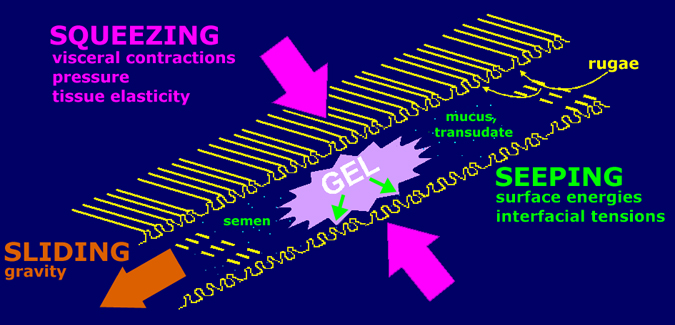
Subprocesses are types of flows that distribute a formulation. They include:
- Squeezing between apposing epithelial surfaces
- Shearing during coitus
- Sliding due to gravity
- Seeping into rugae
- Miscibility and mixing, and retention phenomena on surfaces
Gel properties are measured, including effects of dilution with ambient fluids.
- Viscosity
- Stress growth and relaxation
- Viscoelasticity
- Residual stress
- Yield stress
- Adhesive properties
- Surface properties
In vitro experimental simulations are laboratory experiments that simulate individual and combinations of subprocesses. Results are compared with predictions of mathematical models of the same subprocesses. Current simulations include squeezing and sliding flows and a new assay of the erosion of surface coating due to shearing and dilution with ambient vaginal fluids.
Mathematical Modeling of Deployment
We compare the information obtained from our in vitro experiments with mathematical models that predict formulation deployment characteristics, such as coating flow rates and thicknesses. These models include formulation properties, and also anatomical, mechanical and other characteristics of the in vivo environment experienced by formulations.
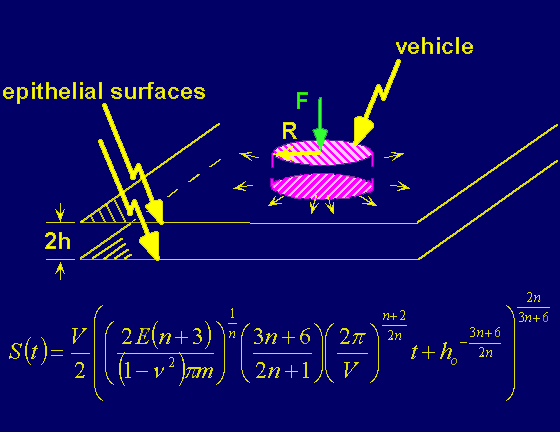
Here is an example of an initial model of the squeezing process that contributes to formulation distribution in the vagina. The model takes into account:
(1) mechanical properties of the vaginal walls – assumed here to be linearly elastic, with Young's modulus E and Poisson's ratio ν
(2) non-Newtonian rheological properties of the formulation – assumed be shear thinning (power law model) with consistency index m and exponent n
(3) details of formulation application – assumed to have an axysymmetric ‘hockey puck' shape, of volume V and initial height (i.e. vaginal wall distention) ho
The following formula gives S(t), net surface area coated, versus time t after formulation insertion. This formula illustrates the multivariate, non-linear tradeoffs in how details of the vaginal environment, the formulation, and its application impact the spreading process over the vaginal epithelium.